Risk Management
Security Risk Management Services
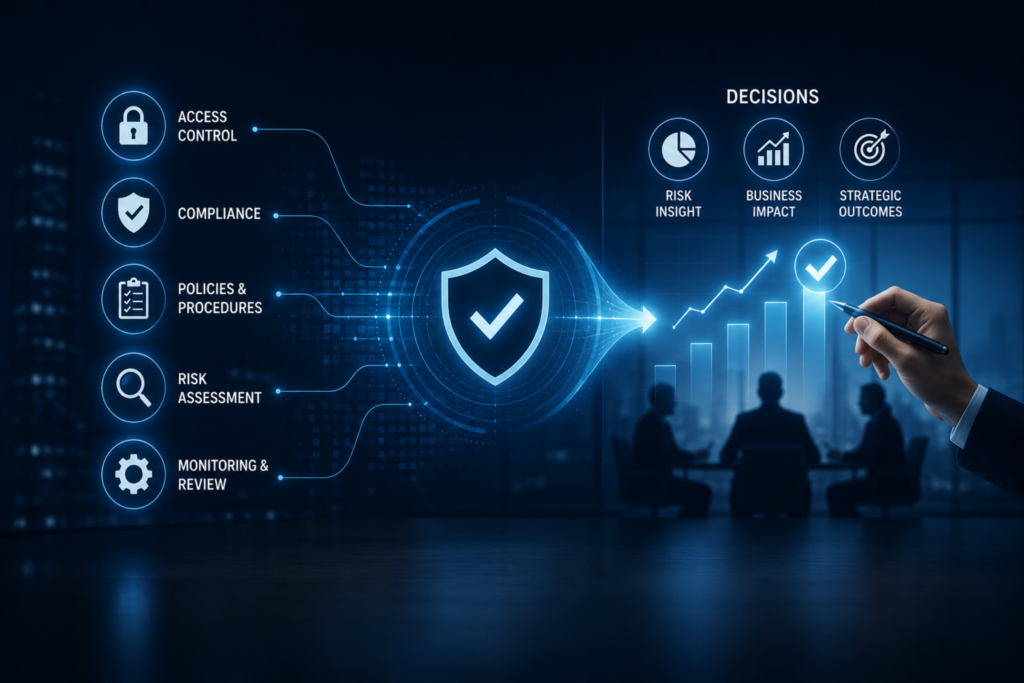
Security decisions are strongest when guided by a clear understanding of risk not assumptions, tool alerts, or isolated technical findings.
Why It Matters
Why Security Risk Management Matters
A structured risk management process turns scattered observations into a consistent, defensible basis for action framing risk in terms of likelihood, impact, treatment options, and organisational priorities. This is the foundation of every mature security programme.
This is especially valuable when strengthening governance, preparing for ISO 27001, reviewing critical systems, managing supplier exposure, supporting audits, or building a more mature security roadmap.
What we offer
Comprehensive Cybersecurity & AI Security Services
Examine threat sources, vulnerabilities, business dependencies, and likely failure or attack events to build a complete picture of credible risk scenarios and their potential consequences.
Assess each risk based on likelihood, impact, existing control effectiveness, and asset significance enabling consistent comparison and business-aligned prioritisation rather than technical severity rankings alone.
Define practical treatment actions reduce, accept, transfer, or avoid and establish ongoing monitoring to ensure the risk picture remains current as systems, threats, and business priorities evolve.
ISO/IEC 27005 provides guidance for managing information security risks in support of an ISMS. ISO 31000 sets out broader principles for identifying, analysing, evaluating, treating, monitoring, and communicating risk. NIST SP 800-30 offers structured assessment guidance. Our service translates these frameworks into practical, business-relevant action — not compliance box-ticking.
What's Included
What the Service Includes
We identify what must be protected and what credible events could cause harm using both asset-centred and scenario-driven approaches. ISO/IEC 27005 supports structured risk identification and assessment approaches tailored to information security environments. This ensures coverage of both known asset exposure and less obvious scenario-based risk paths that asset lists alone would miss.
- Asset Inventory
- Threat Scenarios
- ISO/IEC 27005
- Business Context
We evaluate how security events could affect operations, data, services, and stakeholders by analysing threat sources, vulnerabilities, likelihood, and business impact. NIST SP 800-30 identifies these as core components of a structured risk assessment. Our analysis translates technical findings into business language, enabling leadership-level decision-making.
- Threat Analysis
- Vulnerability Review
- Likelihood Assessment
- NIST SP 800-30
- Impact Scoring
We review existing safeguards to determine whether controls are in place, operating as intended, and sufficient for the level of risk identified. NIST risk management guidance links risk assessment to control assessment and ongoing monitoring. Many organisations discover that controls they assumed were effective have coverage gaps or operational weaknesses that leave residual risk unmanaged.
- Control Assessment
- Gap Identification
- Residual Risk
- NIST Alignment
Once risks are evaluated, we define practical treatment actions and improvement priorities. Recommendations may include control enhancement, security architecture changes, governance improvements, supplier risk actions, or a phased remediation roadmap. ISO/IEC 27005 and ISO 31000 both treat risk response and continual improvement as central parts of a mature risk management process.
- Reduce / Accept / Transfer / Avoid
- Treatment Roadmap
- ISO/IEC 27005
- Governance Alignment
Where external vendors, service providers, or dependencies materially affect your exposure, we extend the risk assessment to cover supply chain factors. NIST guidance explicitly includes external dependencies and supply chain considerations within risk assessment activities. Third-party relationships are a leading source of unmanaged organisational risk especially for cloud-dependent and API-connected architectures.
- Vendor Risk
- Supply Chain Analysis
- External Dependencies
- NIST Guidance
We provide guidance for maintaining an accurate risk picture as systems, threats, and business priorities evolve. ISO/IEC 27005 and ISO 31000 both include monitoring and review as essential ongoing activities within a mature risk management programme. Risk management is a continuous process, not a one-time assessment exercise.
- Continuous Monitoring
- Review Cadence
- ISO/IEC 27005
- ISO 31000
- Risk Maturity
Business Value
Benefits of Security Risk Management
A structured risk view replaces scattered findings with a defensible, prioritised picture of what actually threatens your organisation enabling meaningful security improvement.
Formal risk assessments are a prerequisite for ISO 27001 certification, GDPR accountability, and a range of other regulatory obligations.
Third-party and supply chain risks often the most overlooked source of exposure are surfaced, evaluated, and incorporated into the treatment plan alongside internal risks.
Leadership teams gain a structured, evidence-based basis for security investment and remediation decisions replacing gut instinct with documented risk analysis and treatment rationale.
Risk assessments evaluated by business impact not just technical severity ensure security investment is directed where it produces the greatest reduction in real organisational exposure.
Monitoring and review recommendations keep the risk register current as business conditions, technology, and threat landscapes evolve building lasting security maturity over time.
Who Benefits
Who Needs This Service?
It is particularly relevant for organisations formalising governance, approaching certification, managing critical systems, addressing supplier exposure, or seeking a defensible basis for security investment decisions.
Complex environments with governance obligations, audit requirements, and leadership accountability for risk decisions
Cloud-native and API-driven platforms with customer data exposure and SOC 2 or ISO 27001 compliance requirements
High-value transaction environments facing regulatory mandates under DORA, PCI DSS, and financial sector risk requirements
PHI-handling environments with GDPR, ISO 27001, and ransomware exposure requiring structured risk identification and treatment
Critical infrastructure and public service environments with NIS2, NIST, and national security risk governance requirements
Teams building or maturing an ISMS where ISO/IEC 27005-aligned risk assessment is a core certification requirement
Our Approach
How We Approach Risk Management
A structured, six-stage engagement methodology from defining scope and context through to treatment planning and ongoing monitoring guidance.
We begin by defining the scope of the assessment and identifying critical assets, systems, business processes, stakeholders, and organisational objectives. Effective risk management depends on clear context, relevant assumptions, and a well-defined scope all reflected in recognised standards and risk assessment guidance.
We identify relevant risk scenarios by examining threat sources, vulnerabilities, predisposing conditions, business dependencies, and likely failure or attack events. NIST SP 800-30 describes risk assessment as a process that considers threat sources, threat events, vulnerabilities, likelihood, and adverse impacts all of which inform our identification methodology.
Each identified risk is assessed based on likelihood, impact, existing control effectiveness, and the significance of the affected asset or process. This enables decision-makers to compare risks consistently and prioritise action based on business consequence rather than technical severity alone a distinction that matters significantly when allocating remediation resources.
Once risks are evaluated, we define practical treatment actions and improvement priorities including control enhancement, security architecture changes, governance improvements, supplier risk actions, or a phased remediation roadmap. ISO/IEC 27005 and ISO 31000 both treat risk response and continual improvement as central components of a mature risk management process.
We produce a structured risk register, threat and vulnerability summary, control effectiveness review, prioritised treatment plan, and monitoring guidance outputs that can be used by leadership, security teams, auditors, and operational stakeholders to drive tangible improvement and support governance accountability.
Risk assessments should be reviewed regularly and updated when systems, suppliers, business operations, regulatory requirements, or threat conditions change. Monitoring and review are treated as ongoing responsibilities in both ISO and NIST risk management guidance — not optional activities to be deferred until the next audit cycle.